


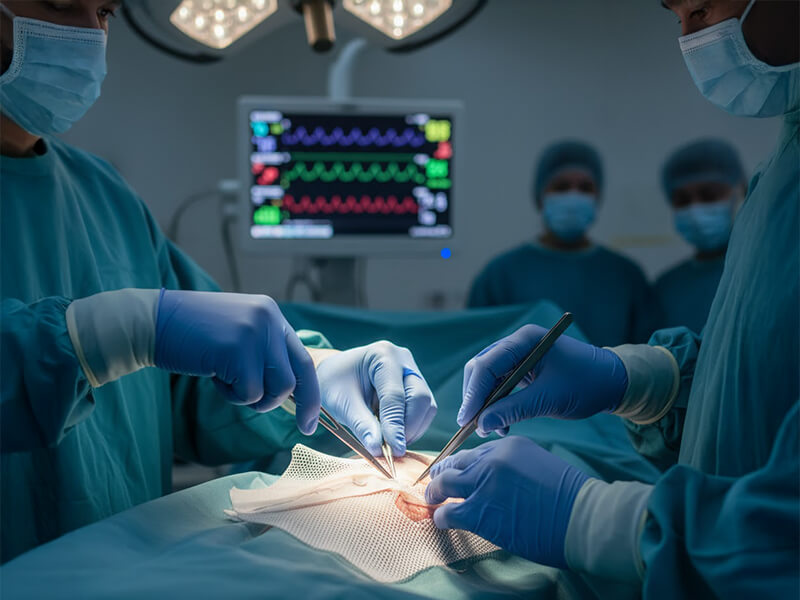
Parastomal Hernia
A parastomal hernia is a pathological protrusion of abdominal contents, primarily the small intestine- though other organs may also be involved- through the opening in the abdominal wall where a stoma has been created. This type of postoperative hernia is a complication following stoma formation and affects approximately 50% of patients who have undergone the procedure.
Parastomal hernias typically develop within the first two years after stoma formation but can appear even several years or decades after surgery. There are two types:
What Is a Parastomal Hernia?
A parastomal hernia occurs when abdominal organs protrude through the abdominal wall opening created for a stoma. It is a common postoperative complication and may affect up to half of all patients with a stoma.
Parastomal hernias most often develop within two years of surgery but may occur many years later. They can be classified as either true or pseudo-parastomal hernias, depending on whether the stoma opening itself widens or whether surrounding tissues loosen.
What Are the Causes of a Parastomal Hernia?
The widening of a stoma opening is primarily influenced by shearing forces that weaken the abdominal wall and increase intra-abdominal pressure- for example, during sneezing, coughing, vomiting, walking, or lifting heavy objects.
Factors that increase the risk include:


What Are the Symptoms of a Parastomal Hernia?
The most characteristic symptom is a soft bulge around the stoma. This bulge typically:
Other symptoms may include:
Emergency symptoms requiring urgent surgery:
How Is a Parastomal Hernia Treated?
Early preventative measures include wearing a hernia support belt and reinforcing the stoma opening using polypropylene mesh.
Surgical intervention becomes necessary when:
Stoma relocation or narrowing the opening with sutures is rarely performed today due to high recurrence rates.
Because parastomal hernia repair is complex, surgery is increasingly performed using minimally invasive methods such as laparoscopy or robotic surgery from within the abdominal cavity.
Advantages of minimally invasive repair include:
A European multi-centre study involving 61 patients undergoing laparoscopic Sugarbaker repair showed that:
What Is the Cost of Parastomal Hernia Surgery?
The cost of private parastomal hernia repair depends on factors such as:
Details of the procedure, available surgical options, and overall costs are discussed during a preoperative consultation with the lead surgeon.
Disclaimer
*The Pax Medicus website provides information for guidance only and does not constitute medical advice, diagnosis, or treatment. Pax Medicus does not provide healthcare services and is not a substitute for consultation with a qualified medical professional. Always seek advice from your physician regarding any medical condition. Prices shown are indicative only and subject to confirmation by the healthcare provider. This is the official website of Pax Medicus; we do not operate through agents or third-party sites.
BOOK YOUR CONSULTATION TODAY
Simply fill in the form below and our team will get back to you as soon as possible.