


Surgical Treatment of Scoliosis
Pax Medicus connects patients with experienced spinal surgeons. Our partner centres use modern techniques to correct spinal curvature, relieve nerve compression, and restore balanced posture with safer, more predictable recovery. Diagnostic tests can also be performed preventively to provide peace of mind, even when no symptoms are present.
What is scoliosis?
Scoliosis is a three-dimensional curvature of the spine that alters alignment in all planes. The spine curves sideways (frontal plane), twists (transverse plane), and often flattens (sagittal plane). Scoliosis is diagnosed when imaging (e.g., X-ray) shows a curvature > 10° in the frontal plane. It most often affects the thoracic or thoracolumbar region; isolated lumbar scoliosis is rarer. Beyond spinal deformity, scoliosis may affect the pelvis, chest, and lower limbs and can change the position of internal organs (heart, lungs, digestive tract), leading to functional problems.
Grading by curvature size
Scoliosis – who is affected?
Children are most at risk; the condition can appear at different growth stages:
In most children, the first signs of spinal deformity appear between the ages of 5 and 8 or during adolescence.
In adults, scoliosis is usually a result of spinal ageing and degeneration of the intervertebral joints. Adult scoliosis generally produces curvatures up to 20–30 degrees. Treatment is mainly based on targeted exercises and physiotherapy, while surgical intervention is reserved for patients with severe pain, neurological symptoms, or significant mobility restrictions.
What are the Categories of scoliosis?
What are the symptoms of scoliosis?
Typical signs include visible spinal asymmetry and changes in body alignment:
How is scoliosis diagnosed?
Diagnosis is made by an orthopaedic specialist using:
What does surgical treatment of scoliosis involve?
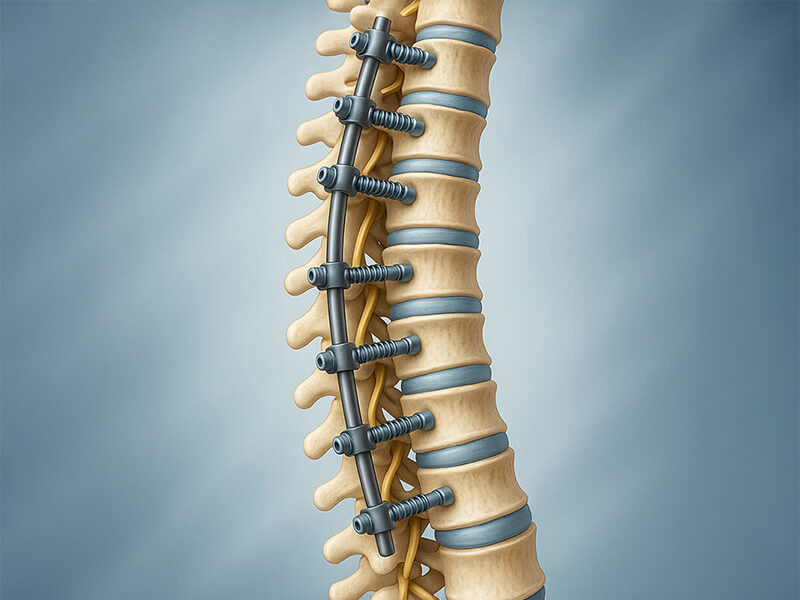
Surgery is considered for curvatures >50° that cause pain, neurological deficits, marked postural deterioration (waist/shoulder blade asymmetry, rib hump progression), gait problems or neurogenic claudication, and cardiorespiratory compromise. The goals are to halt progression, correct curvature, decompress neural elements, restore trunk balance, and stabilise the spine using titanium implants.
Posterior spinal fusion
Most common method for patients in or past puberty with single or double curves. Performed from the back; screws and rods correct the deformity in three planes.
Anterior spinal fusion
Used for selected single short-curve scoliosis. Incision along the lateral chest/abdomen; a rod fixed with screws inserted into vertebral bodies achieves correction.
Indication
>50° curvature / symptoms or deficits
Implants
Titanium screws & rods
Goals
Correction, balance, decompression, stability
Recovery and next steps
Detailed recovery plans vary by curve type and procedure. Your specialist team will advise on mobilisation, bracing (if needed), physiotherapy, and the expected timeline for returning to study, work, and sport.
Your journey step by step
Exam & X-ray/MRI review
Conservative vs surgical options
Posterior or anterior fusion
Mobilisation & physiotherapy
Imaging & posture optimisation
Imaging & posture optimisation
Disclaimer
*The Pax Medicus website provides information for guidance only and does not constitute medical advice, diagnosis, or treatment. Pax Medicus does not provide healthcare services and is not a substitute for consultation with a qualified medical professional. Always seek advice from your physician regarding any medical condition. Prices shown are indicative only and subject to confirmation by the healthcare provider. This is the official website of Pax Medicus; we do not operate through agents or third-party sites.
BOOK YOUR CONSULTATION TODAY
Simply fill in the form below and our team will get back to you as soon as possible.