


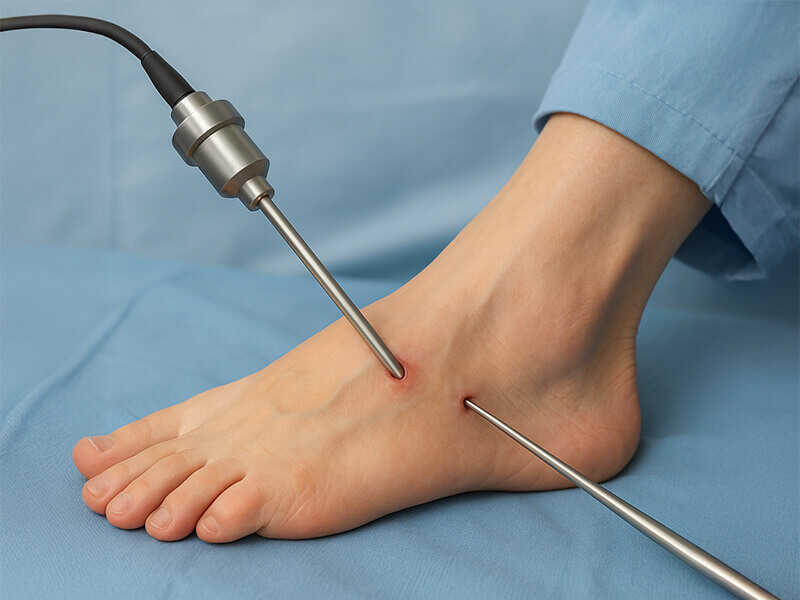
Ankle Arthroscopy
Ankle arthroscopy is a minimally invasive procedure used to diagnose and treat a wide range of ankle problems, helping reduce pain and improve mobility with smaller scars and faster recovery.
What is the ankle joint?
The ankle joint, commonly referred to as the “ankle”, is made up of two interconnected joints that work together to provide stability, movement and balance.
What Is Ankle Arthroscopy?
Ankle arthroscopy is a surgical technique that allows the surgeon to examine and treat structures inside the ankle joint using a miniature camera and fine instruments inserted through small incisions.
How Is Ankle Arthroscopy Performed?
During surgery, the patient lies on their back. A traction device is attached to gently stretch the foot, increasing space inside the joint. Anaesthesia may be:
A tourniquet is placed on the leg to reduce blood flow and improve visibility. A small incision (around 1 cm) is made for the arthroscope, and two additional incisions allow insertion of precision instruments.
Indications for Ankle Arthroscopy
Common reasons for surgery
How arthroscopy helps
Recovery After Ankle Arthroscopy
As with all surgery, post-operative pain and swelling are normal. Pain is controlled with medication, and swelling improves when the leg is elevated.
Weight-bearing
Follow-up & Rehabilitation
Expected timeline
Disclaimer
*The Pax Medicus website provides information for guidance only and does not constitute medical advice, diagnosis, or treatment. Pax Medicus does not provide healthcare services and is not a substitute for consultation with a qualified medical professional. Always seek advice from your physician regarding any medical condition. Prices shown are indicative only and subject to confirmation by the healthcare provider. This is the official website of Pax Medicus; we do not operate through agents or third-party sites.
BOOK YOUR CONSULTATION TODAY
Simply fill in the form below and our team will get back to you as soon as possible.