


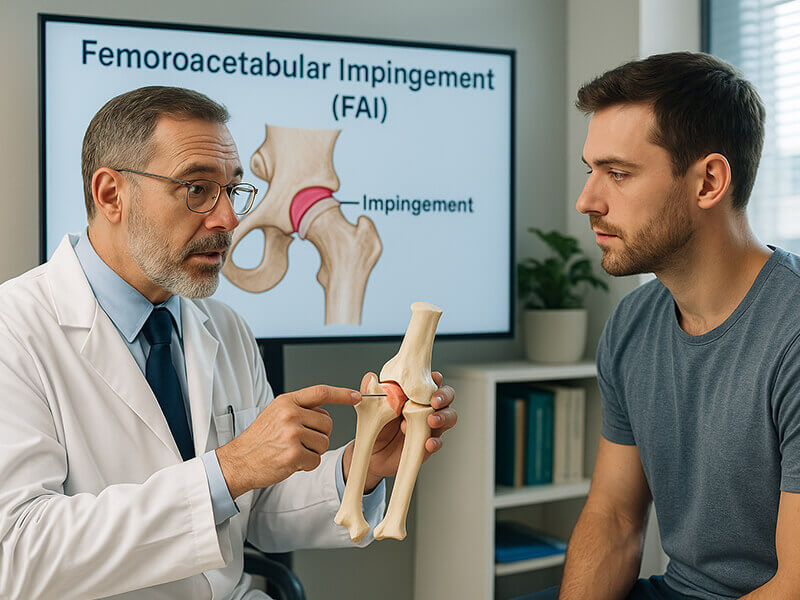
Femoroacetabular Impingement (FAI) Surgery
Femoroacetabular impingement (FAI) is a condition where excess bone on the femoral head or hip socket causes abnormal contact inside the joint, leading to pain, cartilage damage, and limited mobility.
Through partner orthopaedic centres abroad, Pax Medicus – a UK medical tourism agency — coordinates full diagnostic assessment, arthroscopic FAI surgery, and postoperative rehabilitation.
Understanding Femoroacetabular Impingement (FAI)
The hip is a ball-and-socket joint formed by the acetabulum (socket) and the femoral head (ball). These surfaces are covered in cartilage, supported by a cartilage ring called the labrum.
In FAI, excess bone causes the femoral head and acetabulum to collide abnormally. This leads to labral tears, cartilage wear, pain, and restricted movement.
How Is FAI Diagnosed?
A thorough clinical examination is essential. Pain is typically triggered when the hip is flexed, adducted, and internally rotated.
Orthopaedic Assessment
Imaging
How Does FAI Develop?
The exact cause is unclear, but most specialists believe it arises from developmental irregularities in hip shape. Symptoms often appear earlier in physically active individuals who frequently use deep hip flexion.
CAM Impingement
PINCER Impingement
Mixed Type
Symptoms of Femoroacetabular Impingement
Common Symptoms
Long-term Effects
Treatment Options for FAI
Non-surgical Treatment
Non-surgical treatment is suitable for mild cases without major mechanical abnormalities.
When Surgery Is Recommended
Arthroscopic hip surgery aims to restore smooth joint movement and prevent long-term degeneration.
FAI Arthroscopic Surgery – What Happens?
The procedure is performed under spinal or general anaesthesia, with the patient lying on their back.
Step-by-step Procedure
Surgery typically lasts 1–2 hours, depending on severity.
Recovery After FAI Surgery
Athletes receive a tailored rehabilitation plan to support a safe return to sport.
Disclaimer
*The Pax Medicus website provides information for guidance only and does not constitute medical advice, diagnosis, or treatment. Pax Medicus does not provide healthcare services and is not a substitute for consultation with a qualified medical professional. Always seek advice from your physician regarding any medical condition. Prices shown are indicative only and subject to confirmation by the healthcare provider. This is the official website of Pax Medicus; we do not operate through agents or third-party sites.
BOOK YOUR CONSULTATION TODAY
Simply fill in the form below and our team will get back to you as soon as possible.