
Hip Joint Replacement (Endoprosthesis)  | PAX Medicus Medical Tourism UK

Hip Joint Replacement (Endoprosthesis)

Hip replacement surgery is performed when the hip joint is severely damaged, causing persistent pain, stiffness and mobility limitations. It restores comfort, walking ability and long-term quality of life.

Pax Medicus, a UK medical tourism agency, coordinates hip replacement procedures at trusted partner orthopaedic centres abroad, offering high-quality care and clear treatment pathways.

What Is Hip Osteoarthritis?

Hip osteoarthritis does not affect only older people. Symptoms may appear from the age of 45 or even earlier. Without proper treatment, symptoms worsen over time, causing:

  • Pain in the groin, hip or buttock.
  • Limping or swaying while walking.
  • Stiffness, especially in the morning.
  • Reduced range of motion.
  • Clicking or popping sensations in the hip.
  • Weakness of thigh and buttock muscles.

These symptoms develop because the cartilage within the hip joint becomes thinner, loses elasticity and stops absorbing shock. The resulting friction leads to inflammation and reduced joint mobility.

Diagnosis of Hip Osteoarthritis

Diagnosis typically involves a clinical examination and an X-ray, which helps identify:

  • Joint space narrowing due to cartilage loss.
  • Bone thickening or cyst formation.
  • Osteophytes (bone spurs).

In some cases, an MRI may be required to assess damage to the labrum and joint cartilage in more detail.

Causes of Hip Osteoarthritis

Primary Osteoarthritis

  • Natural ageing processes.
  • Gradual cartilage wear.

Secondary Osteoarthritis

  • Hip dysplasia (congenital abnormalities).
  • Inflammatory joint disease (e.g., rheumatoid arthritis, gout).
  • Previous hip fractures or dislocations.
  • Occupational strain and repetitive loading.
  • Excess body weight or obesity.

Surgery is recommended when hip damage is significant, causing chronic pain at rest and limited movement. When conservative treatments no longer help, hip replacement becomes the most effective treatment option.

  • Advanced osteoarthritis.
  • Rheumatoid or inflammatory joint disease.
  • Complications after fractures around the hip.
  • Femoral neck fractures.
  • Early-stage avascular necrosis.
  • Tumours involving the hip joint.

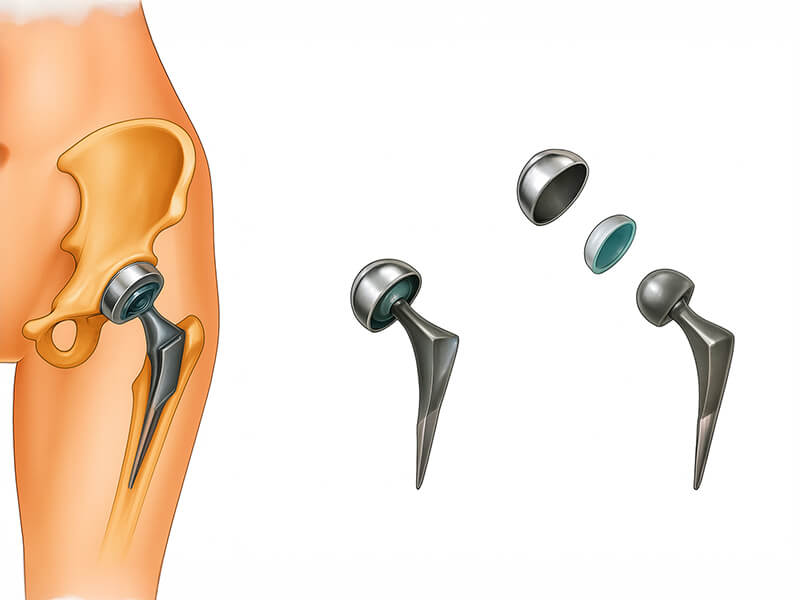
A hip endoprosthesis replaces the damaged joint with an artificial implant made from biocompatible materials such as titanium. It consists of:

  • A femoral stem inserted into the thigh bone.
  • A metal or ceramic head that acts as the ball.
  • An acetabular cup (socket) implanted in the pelvis.

These components work together to replicate the natural mechanics of the hip.

Modern implants are highly durable and can last for decades. In rare cases, the prosthesis may wear out, loosen or dislocate. Revision hip replacement surgery can correct these issues when needed.

Types of Hip Replacements

Cemented Prosthesis

  • Fixed using bone cement.
  • Used for older adults or those with weaker bone quality.

Cementless Prosthesis

  • Press-fit design integrates naturally with the bone.
  • Suitable for younger patients with good bone strength.

Hybrid Prosthesis

  • Combination of cemented and cementless components.
  • Offers stability depending on patient anatomy.

How Hip Replacement Surgery Is Performed

The procedure typically lasts 1–2 hours and is performed under spinal or epidural anaesthesia.

  • The surgeon makes an incision to access the hip joint.
  • The damaged femoral head and neck are removed.
  • The bone is prepared for the prosthesis.
  • The acetabular cup is implanted first.
  • The femoral stem and head are then placed.
  • Soft tissues are reconstructed and the wound is sutured.

Drains may be inserted temporarily to remove excess blood.

Risks and Possible Complications

  • Infection around the implant.
  • Venous thrombosis or pulmonary embolism.
  • Limb length discrepancy.
  • Joint stiffness or reduced mobility.
  • Prosthesis loosening or dislocation.
  • Allergic reaction to implant materials.

Complications are rare, especially with modern implants and enhanced recovery pathways.

Do Hip Prostheses Need to Be Replaced?

Modern implants are highly durable and can last for decades. In rare cases, the prosthesis may wear out, loosen or dislocate. Revision hip replacement surgery can correct these issues when needed.

Life After Hip Replacement

Most patients stay in hospital for 5–6 days. Antibiotics and thromboprophylaxis are routinely used after surgery. Patients begin walking with crutches the day after surgery, with gradual weight-bearing.

  • Walking independently usually begins within weeks.
  • Full recovery typically takes around 3 months.
  • Recommended activities: walking, cycling, swimming.

Hip replacement allows patients to return to daily life, eliminate pain and regain independence.

Life After Hip Replacement | PAX Medicus Medical Tourism UK

Disclaimer
*The Pax Medicus website provides information for guidance only and does not constitute medical advice, diagnosis, or treatment. Pax Medicus does not provide healthcare services and is not a substitute for consultation with a qualified medical professional. Always seek advice from your physician regarding any medical condition. Prices shown are indicative only and subject to confirmation by the healthcare provider. This is the official website of Pax Medicus; we do not operate through agents or third-party sites.

BOOK YOUR CONSULTATION TODAY


Simply fill in the form below and our team will get back to you as soon as possible.