


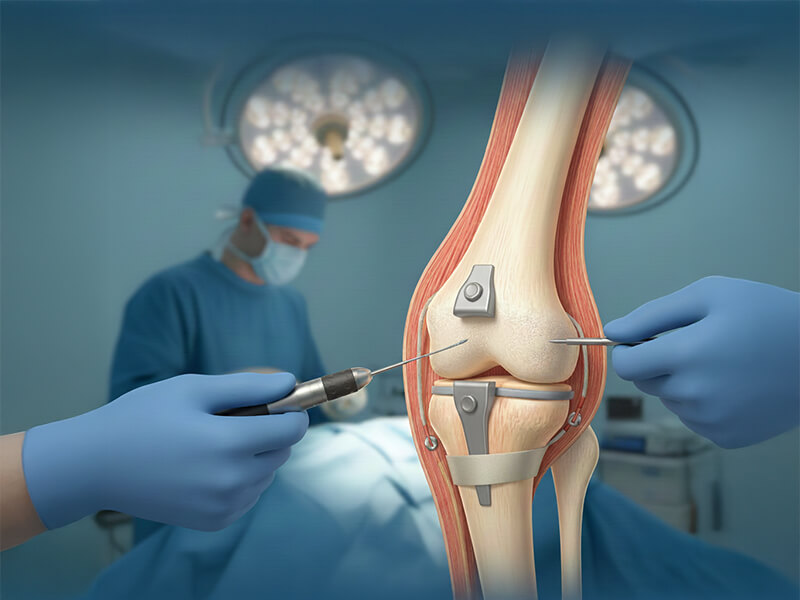
High Tibial Osteotomy (HTO)
High tibial osteotomy is a joint-preserving knee surgery used to correct leg alignment and shift body weight away from the damaged part of the knee. It can reduce pain, improve function and delay or prevent the need for total knee replacement in selected patients with varus (“bow-legged”) deformity.
Through partner orthopaedic centres abroad, Pax Medicus coordinates diagnostics, high tibial osteotomy surgery and tailored rehabilitation pathways for patients with early–moderate medial compartment osteoarthritis and malalignment.
What Are Knee Degenerative Changes?
The knee is the largest joint in the human body and is exposed to substantial mechanical stress in everyday life. When the limb is aligned correctly, these forces are distributed evenly and the joint structures are protected.
If the alignment is disturbed, more load is placed on one side of the knee. In varus deformity (“bow-legged” position), the lower leg deviates inward relative to the thigh. This increases pressure on the medial (inner) compartment, especially the articular cartilage and medial meniscus, leading to joint degeneration and osteoarthritis.
Malalignment can result from congenital limb deformities, cartilage damage in childhood, trauma, metabolic diseases, bone tumours or metastases affecting the femur or tibia.
What Is Osteotomy?
Osteotomy is a surgical procedure in which the bone is cut, repositioned and stabilised to correct alignment and change how forces pass through a joint. In the knee, a high tibial osteotomy targets the upper part of the shinbone (tibia) to shift body weight away from the damaged medial compartment and onto healthier cartilage.
When Is High Tibial Osteotomy Recommended?
High tibial osteotomy is mainly recommended for younger or middle-aged patients who have pain from medial compartment osteoarthritis and varus deformity, but who still have reasonably preserved cartilage elsewhere in the knee.
Typical candidates
Goals of the procedure
Key selection factors
High tibial osteotomy is generally not suitable for patients with advanced, multi-compartment osteoarthritis, severe joint stiffness or inflammatory arthritis affecting the entire knee.
Closing-Wedge vs Opening-Wedge Osteotomy
Closing-wedge osteotomy
Opening-wedge osteotomy
As with any surgery, high tibial osteotomy carries risks. Possible complications include over- or under-correction, delayed bone healing, infection and thrombosis. Following your surgeon’s instructions, including thromboprophylaxis, is essential to minimise these risks.
Recovery After High Tibial Osteotomy
Hospital stay is usually short. Many patients go home the same day or after one night in hospital, depending on their general condition and local protocol. Rehabilitation starts very early, often on the day of surgery.
Immediately after surgery
Weight-bearing and mobility
Rehabilitation goals
Every rehabilitation plan is individual. Closely following the guidance of your surgeon and physiotherapist is crucial for a stable, well-aligned and pain-reduced knee.
Disclaimer
*The Pax Medicus website provides information for guidance only and does not constitute medical advice, diagnosis, or treatment. Pax Medicus does not provide healthcare services and is not a substitute for consultation with a qualified medical professional. Always seek advice from your physician regarding any medical condition. Prices shown are indicative only and subject to confirmation by the healthcare provider. This is the official website of Pax Medicus; we do not operate through agents or third-party sites.
BOOK YOUR CONSULTATION TODAY
Simply fill in the form below and our team will get back to you as soon as possible.