


Rotator Cuff Surgery
The rotator cuff is crucial for shoulder stability and rotation. When its tendons are damaged or torn, surgery may be required to restore strength, movement and function. Prompt treatment is important, as untreated tears can progress and lead to increasing weakness and long-term shoulder dysfunction.
What is the rotator cuff and what is its function?
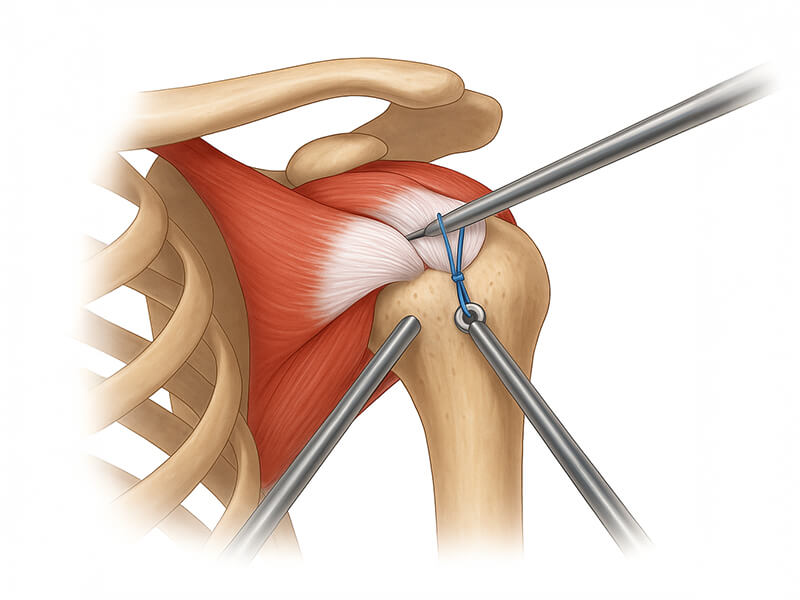
The rotator cuff is a group of muscles within the shoulder responsible for rotational movements and stabilisation of the shoulder joint. It consists of four muscles – supraspinatus, infraspinatus, teres minor and subscapularis – which extend from the scapula to the humerus.
What does a rotator cuff injury involve and how does it occur?
Damage to the rotator cuff involves injuries to the muscle attachments to the bone, specifically the tendons. This may occur due to the ageing process and natural wear and tear. Small, often unnoticed injuries can gradually lead to larger tears and, eventually, complete tendon rupture.
In younger individuals, rotator cuff injuries are most commonly caused by falls, shoulder dislocations or repetitive overhead activities, typically associated with sports such as tennis or baseball. Risk factors include smoking and hypercholesterolaemia (elevated blood cholesterol levels).
What are the symptoms of a rotator cuff injury?
What are the treatment options for a rotator cuff injury?
What are the treatment options for a rotator cuff injury?
Arthroscopic surgery
Through small skin incisions, a cannula containing a camera and surgical instruments is inserted into the joint. For minor injuries, the surgeon may perform a single-stage tendon repair. In cases of more extensive damage, complete detachment of the tendon from the humerus may be necessary, followed by removal of diseased tissue and reattachment of the tendon to the bone.
Open surgery
Some procedures are performed using the traditional open technique. This method is reserved for larger, more complex rotator cuff injuries. The surgeon accesses the shoulder joint through an incision in the shoulder region and performs all steps under direct visual control rather than using a camera image.
Mini-open technique
The mini-open technique combines elements of both approaches. Part of the procedure is carried out arthroscopically, while the remainder is performed through a smaller incision than in the standard open technique.
What is the rehabilitation process after rotator cuff surgery?
Following surgery, the upper limb must remain immobilised in a special orthosis for four to six weeks. Despite this immobilisation, rehabilitation can begin during this period. Together with a physiotherapist, the patient performs passive movements of the shoulder joint – movements assisted by another person rather than using their own muscle effort.
Once immobilisation is discontinued, rehabilitation focuses on strengthening the muscles and increasing the endurance of the ligaments and tendons within the shoulder. The patient performs active movements, gradually increasing the load and intensity of exercises.
Full recovery of function and strength to pre-injury levels may take several months and depends closely on adherence to rehabilitation guidelines.
Disclaimer
*The Pax Medicus website provides information for guidance only and does not constitute medical advice, diagnosis, or treatment. Pax Medicus does not provide healthcare services and is not a substitute for consultation with a qualified medical professional. Always seek advice from your physician regarding any medical condition. Prices shown are indicative only and subject to confirmation by the healthcare provider. This is the official website of Pax Medicus; we do not operate through agents or third-party sites.
BOOK YOUR CONSULTATION TODAY
Simply fill in the form below and our team will get back to you as soon as possible.