


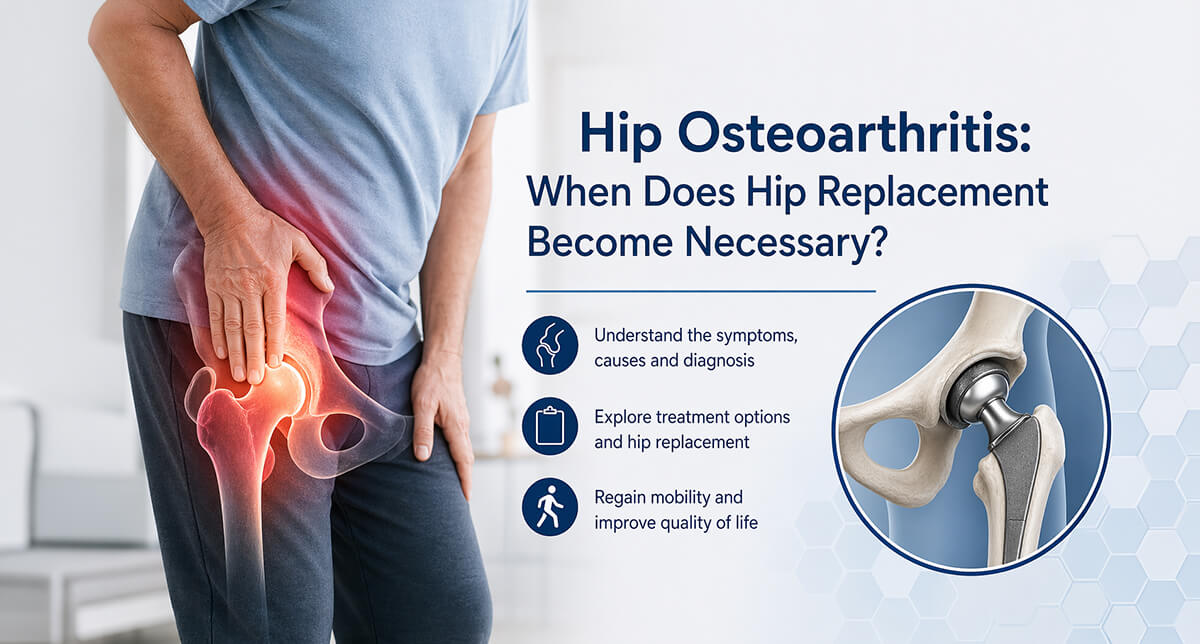
Hip Osteoarthritis: When Does Hip Replacement Become Necessary?
Hip osteoarthritis is a degenerative joint condition that mainly affects people over the age of 60, although it can also develop earlier. It is often accompanied by persistent pain that worsens during movement and, over time, may lead to gait problems, stiffness and a significant reduction in quality of life.
When treatment no longer brings relief and degenerative changes make normal daily functioning impossible, hip replacement surgery may become the only effective solution. For UK patients considering orthopaedic treatment in Poland, understanding the symptoms, causes and treatment options for hip osteoarthritis is the first step towards regaining mobility and independence.
Hip Osteoarthritis: Symptoms and Disease Progression
The first symptoms of hip osteoarthritis often appear after the age of 45 and may gradually worsen over time. Pain is usually felt in the groin, hip or buttock and is often most noticeable in the morning or after physical activity.
- Pain in the groin, hip or buttock
- Morning stiffness, especially after getting out of bed
- Pain that worsens during long walks or sport
- Limping or swaying to one side while walking
- Reduced range of movement in the hip joint
- Clicking or cracking sensations in the hip
- Weakness in the thigh and buttock muscles
Without proper treatment, pain gradually becomes more severe and may start to affect normal walking, sleep and everyday activities. In advanced cases, the disease can significantly reduce independence and quality of life.
What Causes Hip Osteoarthritis?
The main cause of symptoms is the gradual loss of the regenerative capacity of the articular cartilage. As the cartilage becomes thinner and less elastic, it can no longer absorb load properly. This leads to friction between the head of the femur and the hip socket, which in turn causes inflammation, pain and restricted movement.
Hip osteoarthritis may be primary, related mainly to age-related wear and tear, or secondary, where other underlying problems contribute to joint damage.
- Natural wear and tear of joint cartilage
- Congenital hip defects such as dysplasia
- Inflammatory joint diseases, including rheumatoid arthritis or gout
- Hip injuries, fractures or repeated microtrauma
- Genetic predisposition
- Overweight and obesity
Lifestyle-related factors are also important, especially excess body weight, because additional pressure on the joint can speed up cartilage wear and worsen symptoms.
Diagnosing Hip Osteoarthritis
Diagnosis begins with a detailed medical history and a physical examination performed by an orthopaedic specialist. Imaging tests are then used to confirm degenerative changes and assess how advanced the condition is.
- X-ray of the hip joint to assess degenerative changes
- MRI scan for detailed evaluation of cartilage and labrum damage
- Full blood count and inflammatory markers such as CRP and ESR
- Additional blood tests, including rheumatoid factor or uric acid if needed
Typical X-ray findings may include narrowing of the joint space, increased bone density and bony growths known as osteophytes. Patients looking for private assessment can also explore medical tests and examinations available through Pax Medicus.
When Is Hip Replacement Surgery Indicated?
Hip replacement becomes necessary when the joint is critically and irreversibly damaged, causing constant pain and major restriction of movement. It is usually considered when other forms of treatment no longer bring meaningful improvement.
- Constant pain, including pain at rest
- Severe limitation of joint movement
- No improvement despite medication or conservative treatment
- Rheumatic joint disease
- Consequences of fractures around the hip joint
- Fracture of the femoral neck
- Early avascular necrosis
- Cancer-related disease affecting the hip joint
For many patients, surgery is the step that makes it possible to return to walking, sleeping and functioning without constant pain.
What Is a Hip Endoprosthesis?
A hip endoprosthesis, also called an artificial hip joint, is an implant that replaces the damaged natural joint. During surgery, the worn surfaces of the hip are removed and replaced with artificial components made from biocompatible materials such as titanium.
- Stem – placed into the femoral canal
- Spherical head – attached to the stem to allow movement
- Acetabular component – implanted in place of the natural socket
Because these implants are designed to be neutral to the body, the risk of rejection is very low. The movement of the new joint then takes place between the artificial head and the artificial socket.
Types of Hip Replacements
Hip implants are selected according to the patient’s age, bone quality and the way the implant will be fixed to the bone.
- Cemented hip prosthesis – fixed with bone cement, often used in older patients or those with osteoporosis or rheumatoid arthritis
- Cementless hip prosthesis – inserted directly into the bone, usually used in younger patients with stronger bone tissue
- Hybrid hip replacement – combines cemented and cementless fixation methods
The choice of implant is made by the orthopaedic surgeon based on the patient’s anatomy, bone condition and long-term treatment goals.
What Happens During Hip Replacement Surgery?
Hip replacement surgery usually takes between one and two hours, depending on the degree of deformity of the joint. It is typically performed under spinal or epidural anaesthesia.
- The surgeon exposes the diseased joint
- The damaged head and neck of the femur are removed
- The bone bed is prepared for the implant
- The artificial socket is placed into the pelvic bone
- The prosthetic stem is introduced into the femoral canal
- Soft tissues are reconstructed and the wound is closed
Patients considering surgical options can also explore orthopaedic services and more detailed information about hip joint replacement surgery.
What Are the Risks of Hip Replacement Surgery?
Hip replacement is a routine and highly successful operation, but as with any surgery, complications can sometimes occur.
- Mechanical loosening of the implant
- Infection around the prosthesis
- Venous thrombosis
- Change in leg length
- Joint stiffness
- Dislocation or wear of the implant over time
Despite these risks, the outcome is good in the vast majority of cases, especially when surgery is performed by an experienced orthopaedic team and followed by proper rehabilitation.
How Long Does a Hip Prosthesis Last?
Modern hip implants are made from durable, high-quality materials, which means a correctly implanted prosthesis can last for many years, often decades. However, because it is an artificial element, it may eventually wear out or loosen.
If a hip replacement stops functioning properly, it can usually be replaced in a revision hip replacement procedure.
Recovery After Hip Replacement Surgery
The standard hospital stay after hip replacement surgery is usually around five to six days. Rehabilitation and early mobilisation are essential parts of recovery and help reduce complications and restore function.
- Antibiotic cover is commonly used in the first days after surgery
- Thrombosis prevention is continued for several weeks
- Patients are usually mobilised the day after the operation
- Walking with crutches begins early in recovery
- Full return to normal function often takes around three months
- Gradual activity such as walking, cycling or swimming is recommended
Physiotherapy plays a vital role in helping patients regain strength, stability and confidence after surgery.
Hip Replacement in Poland: A Chance to Regain Quality of Life
Hip replacement surgery can relieve persistent pain, restore mobility and make it possible to return to personal and professional activities. For UK patients, treatment in Poland may offer an effective solution when hip osteoarthritis has reached the point where conservative treatment is no longer enough.
You can explore available hospitals, review hip joint surgeries, and learn more about the process here: how treatment in Poland works.
If you would like a personalised treatment pathway, you can book a consultation or review the pricing guide before taking the next step.
Final Thoughts
Hip osteoarthritis is a progressive condition that can gradually reduce mobility, independence and quality of life. When pain becomes constant and joint damage is irreversible, hip replacement surgery may provide the most effective long-term relief.
For patients travelling from the UK, specialist orthopaedic treatment in Poland can offer a practical route to faster diagnosis, effective surgery and structured postoperative recovery.
Private Hip Replacement Assessment and Treatment Support
If you are struggling with hip pain, stiffness or limited mobility, Pax Medicus can help you access specialist orthopaedic services, detailed diagnostics, hip replacement surgery and the option to book a consultation without unnecessary delay.