


Uterine Fibroids: Why It Is Better to Keep Them Under Control
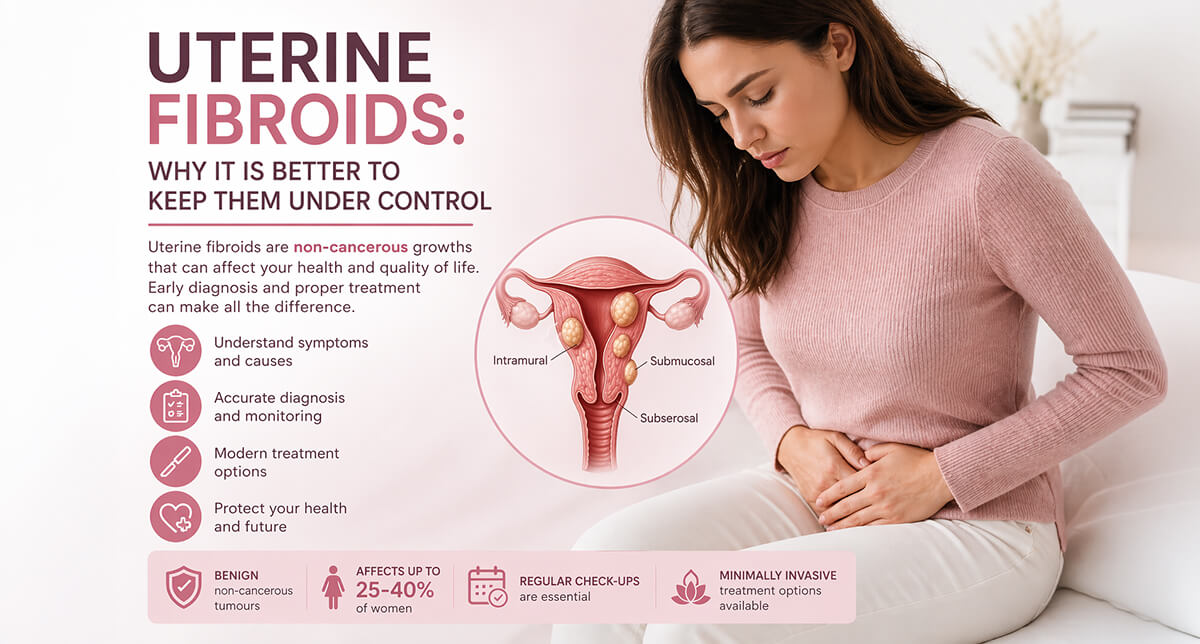
Uterine fibroids are benign tumours that develop from the smooth muscle tissue of the uterus. For many years, fibroids may grow silently and without symptoms, which is why regular gynaecological check-ups are so important. They are most commonly found in women of reproductive age and may affect as many as 25–40% of women.
In many cases, fibroids are found during routine gynaecological examinations, often on ultrasound, where they may appear as very small nodules or as larger growths occupying much of the uterus. Treatment is not always necessary, but once fibroids are diagnosed, regular monitoring is essential to make sure the lesion is not changing in a concerning way.
What Are Uterine Fibroids?
Uterine fibroids are the most common type of non-epithelial, benign uterine tumour. They arise from the smooth muscle cells of the uterus and from the muscle cells of blood vessels. Only a small proportion occur as a single lesion. In most cases, they appear as multiple tumours of different sizes and in different locations.
Depending on where they are located, fibroids can be divided into several main types:
- Intramural fibroids – develop within the wall of the uterus and often do not cause symptoms in the early stages
- Submucosal fibroids – grow towards the uterine cavity and usually produce clearer symptoms
- Subserosal fibroids – are located on the outside of the uterus
- Pedunculated fibroids – are attached to the uterus by a stalk of connective tissue
It is important to remember that fibroids are benign tumours. They do not spread and they do not invade surrounding tissues. However, that does not mean they are harmless. Large or uncontrolled fibroids can lead to serious health consequences and may press on nearby organs such as the bladder, ureter or kidneys. This is why ongoing gynaecological supervision is so important.
How Do Fibroids Develop and Who Is Most at Risk?
In most cases, fibroids are hormone-dependent tumours. They develop as a result of excessively high oestrogen levels or increased sensitivity of uterine cells to oestrogens. This is why the rate of fibroids rises with age during reproductive and premenopausal years and tends to fall after menopause.
Important risk factors include:
- Not having children
- Late motherhood
- An early first period
- Fibroids in close family members
- Obesity
- Diabetes
- High blood pressure
Because these tumours often grow gradually, regular gynaecological assessment is one of the best ways to detect changes early and decide whether monitoring or treatment is needed.
Uterine Fibroids Symptoms
The symptoms of fibroids depend mainly on their size and location. Some patients have no symptoms at all, while others develop symptoms that interfere significantly with daily life.
- Heavy and painful periods
- Lower abdominal or pelvic pain
- Pain and discomfort during intercourse
- Pain in the lumbar spine area
- Frequent urination
- Constipation and bloating
- Difficulty becoming pregnant
- Miscarriages or difficulty carrying a pregnancy to term
When fibroids are larger, symptoms may become more pronounced. Some patients also develop anaemia because of heavy blood loss, as well as recurrent urinary tract infections caused by pressure on the bladder or ureters.
How Are Uterine Fibroids Diagnosed?
Although fibroids may be small and symptom-free, in most cases they can be detected during a transvaginal ultrasound scan. This allows the gynaecologist to assess how many fibroids are present, where they are located and how large they are.
Diagnostic investigations may include:
- Transvaginal ultrasound scan
- Hysteroscopy for better assessment of submucosal fibroids
- MRI scan in more complex cases
- CT scan where advanced imaging is required
- Laboratory tests, depending on symptoms and overall health
Patients looking for private diagnostic pathways can also review available medical tests and examinations before arranging specialist consultation.
Do Fibroids Always Need Treatment?
Fibroids that do not cause symptoms usually do not pose an immediate danger to the patient’s health and, in many cases, do not require active treatment. However, regular monitoring and gynaecological visits remain important in order to check whether the lesions are changing in size or starting to cause complications.
This is one of the main reasons why it is better to keep fibroids under control rather than ignore them completely.
Treatment for Uterine Fibroids
Modern medicine offers a number of treatment options for uterine fibroids. Drug treatment is mainly used to reduce symptoms and slow fibroid growth, while surgical treatment is used when lesions are larger, symptomatic or affecting fertility.
Treatment options may include:
- Medication to control symptoms
- Hormonal treatment to slow growth
- Myomectomy or fibroid enucleation
- Laparoscopic surgery
- Transvaginal minimally invasive procedures
- Robot-assisted surgery in selected cases
At our partner hospital, treatment is aimed at being as uterus-sparing as possible. This means removing fibroids while preserving the uterus whenever feasible, even in the case of very large fibroids. Patients interested in specialist care can also review gynaecology services and gynaecological procedures.
Minimally Invasive and Fertility-Sparing Treatment
Many fibroid procedures can now be performed using minimally invasive techniques. These approaches use very small incisions and advanced visualisation technologies, which can reduce pain, shorten recovery time and help patients return to normal life more quickly.
- Smaller incisions
- Less postoperative pain
- Shorter hospital stay
- Faster recovery
- More precise tissue preservation
- Better support for future fertility planning in selected patients
The final choice of surgical technique depends mainly on the size, number and location of fibroids, as well as the patient’s age and fertility plans.
Is Hysterectomy Always Necessary?
Hysterectomy, or removal of the uterus, is the most invasive surgical treatment for fibroids and is used as a last resort. Such radical treatment is rarely necessary. That is why it is worth verifying and discussing the need for this procedure in an experienced centre before making a final decision.
The best treatment pathway should always be chosen individually, together by the patient and the gynaecologist, with full understanding of the risks, benefits and fertility implications.
Why It Is Better to Keep Fibroids Under Control
Although uterine fibroids are benign, they should not be ignored. Regular monitoring makes it possible to detect growth, assess changing symptoms and decide on treatment before complications become more serious.
With accurate diagnosis, specialist follow-up and access to modern treatment options, many women can control fibroids effectively while preserving both health and quality of life.
Private Fibroid Diagnosis and Treatment Support
If you have been diagnosed with uterine fibroids or are experiencing symptoms such as heavy bleeding, pelvic pain or pressure symptoms, PAX Medicus Medical Tourism Agency can help you access specialist diagnostics, gynaecology services and the option to book a consultation without unnecessary delay.